 Stud Finder

What was tested, and when?
From July 28 to August 3, 2026, we used a simplified magnetic screw model to generate sensor signals for automatic sweep tests. The model gave us known target positions and a way to vary noise and movement. It was useful for tuning the detector, including its smoothing, but it was an approximation: a real screw, handset and magnetic environment need not behave exactly like the model.
After a simpler detection engine was introduced on August 3, a persistent signal still appeared in physical use. That evening, development builds recorded three LG G6 sessions. A test-only recorder sent timestamped X, Y and Z magnetic readings over USB to a laptop. The development report describes a sampling rate of approximately 50 readings per second for this setup. It is not a promised rate for every Android phone.
| Recording | Approximate duration | Question |
|---|---|---|
| Rotation in air | 31 seconds | Does the detector report metal while the phone turns away from nearby metal? |
| Screw sweep | 33 seconds | Does moving the phone past a real screw still produce a detection? |
| Screw close, held, removed | 78 seconds | Does the signal clear after the screw is removed? The sequence was repeated three times, with holds of about six seconds. |
No wall covered the screw in these recordings. Our separate LG G6 and Redmi Note 13 Pro 5G checks through drywall and wood must not be confused with this replay dataset.
Failure 1: turning the phone produced a false signal
In the rotation recording, the measured field magnitude ranged from 30.6 to 75.4 microteslas (µT). The development analysis attributed a substantial part of this variation to the handset's own magnetic offset, estimated at about 27 µT. The earlier detector reported a target during 72% of that no-target recording.
The reported change was to estimate and subtract the phone's magnetic offset, and to restrict which readings were trusted while that estimate was being established. Android's sensor documentation also distinguishes magnetic-field readings from an uncalibrated stream with an iron-bias estimate; that API distinction is background context, not an independent validation of our algorithm.[3]
Failure 2: the screw became the new background
The earlier detector used a change in magnetic-field direction as a cue that the phone had turned. A screw brought close to a stationary phone also changed that direction. In the reported failure, the detector adopted the screw-affected reading as its background, which fell from 50.7 to 11.3 µT. Removing the screw then made the ordinary field look like a large target signal.
The development report describes adding a gravity/tilt check to help decide when to refresh the background. A tilt cue provides information separate from the magnetic reading, but it does not identify the object causing that reading. Gravity alone also cannot reveal every rotation, such as a turn about the gravity axis. We do not treat unchanged tilt as proof that a screw is present.[4]
The held-screw replay
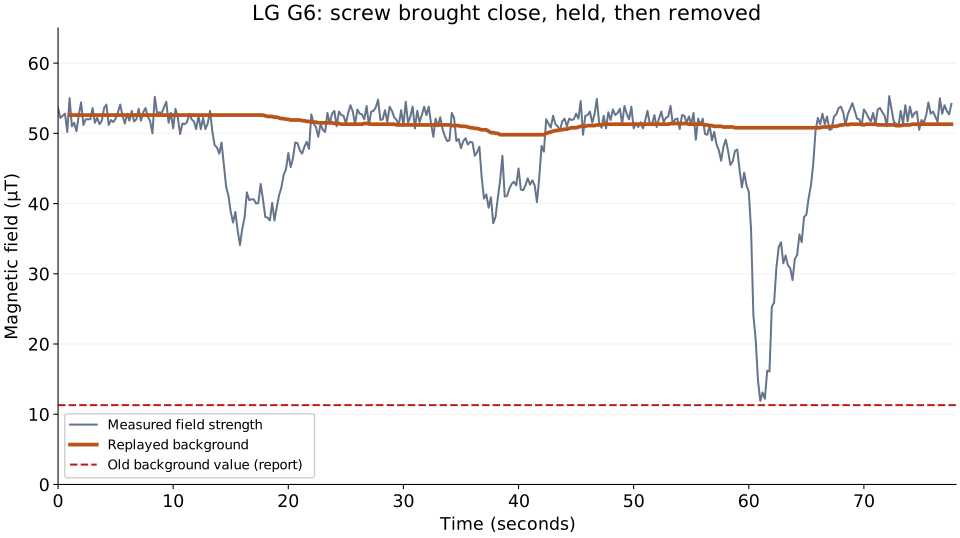
The replayed background stayed between 49.8 and 52.6 µT. The report describes the target indication clearing about one second after screw removal. During the strongest hold, the replay also paused the indication for about 1.5 seconds. That limitation matters: the recordings contain magnetic readings, but no tilt stream, so this replay cannot test the full gravity-assisted path used with live sensor input.
What the reported results mean
| Check | Reported result | Scope |
|---|---|---|
| Rotation without a nearby target | Target reported for about 1% of the time after excluding the first 10 seconds | A time-based false indication on this recording; not 99% product accuracy. The earlier 72% figure was reported for the recording without the same stated exclusion, so the windows are not directly comparable. |
| Screw held, then removed | Background 49.8–52.6 µT; indication clears about 1 second after removal | Three sequences on one phone; the strongest hold included a temporary pause in the replay. |
| Sweep over a screw | Detected before and after the changes; reported replay signal peak 65.9 µT | A processed detector signal, not a universal detection threshold or a measurement of screw depth. |
The report says the three recordings became inputs to six regression checks, all reported passing when rerun on September 28, 2026. Those checks help guard against the recorded failures returning. They do not establish accuracy across other devices, materials or scan conditions.
How to use this finding when scanning
Check sensor compatibility, remove magnetic accessories and keep the phone's orientation consistent while scanning. Use the app's sensor-location feature to identify the sensing area, and look for responses that repeat in the same physical position. A signal that appears everywhere, or remains after moving away from the suspected target, is a reason to investigate interference and setup rather than mark a stud.
Our phone compatibility and setup guide explains the basic checks. Detection is a clue to nearby magnetic material; it does not reveal wood edges, identify live wiring, or certify a drilling point.
Limits and the next measurements
- One recorded handset: all three replay sessions came from an LG G6. The separate Xiaomi material checks do not reproduce this same recording protocol.
- Open-air screw tests: these recordings do not measure detection through drywall, wood, insulation or other wall layers.
- No tilt stream: the magnetic-only replays cannot validate the complete live-sensor behaviour.
- Reduced plotting data: the downloadable CSV preserves the report's rounded chart samples at 0.2-second intervals. It is not the original X/Y/Z recording or a package for rerunning the detector tests.
- No general accuracy score: the report does not provide a balanced trial set across phones or a distribution of centre-location errors. Passing regression checks is not equivalent to a detection-success percentage.
The next useful evidence is synchronized magnetic and motion recordings on additional phones, followed by repeatable checks through measured material thicknesses with independently known screw positions. That would test questions this small dataset cannot answer.